SMPTE ST 2110 monitoring with PTP and ST 2022-7
Every ST 2110 essence, its timing and its protection, checked on live traffic. The probe finds each flow from its packets, without an SDP file, and measures it against ST 2110-21, ST 2059-2 and ST 2022-7.
- ST 2110-10
- ST 2110-20
- ST 2110-21
- ST 2110-22
- ST 2110-30
- ST 2110-31
- ST 2110-40
- ST 2059-2
- ST 2022-6
- ST 2022-7
- AES67
- IEEE 1588 PTPv2
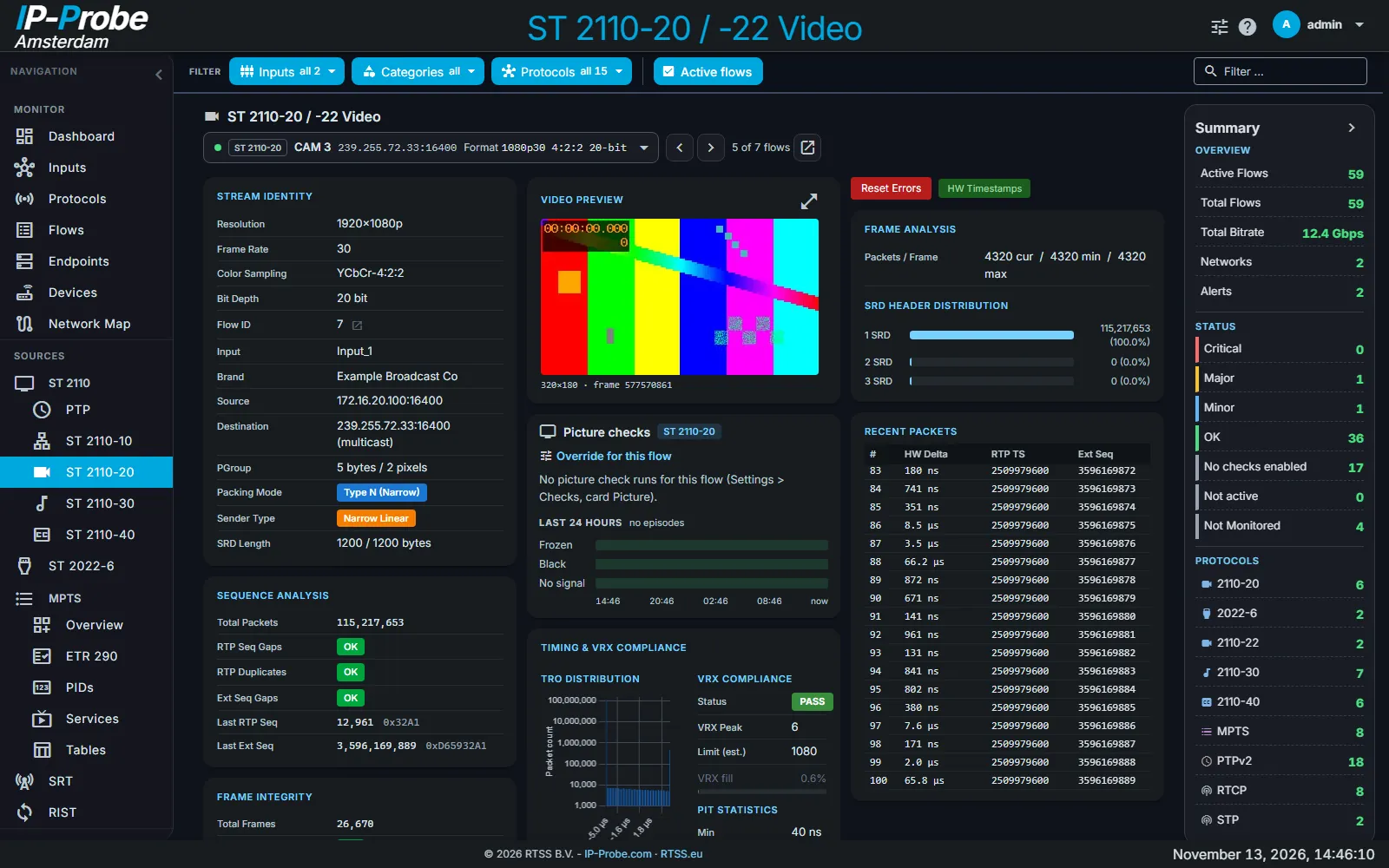
Video: loss, timing and the picture
Resolution, frame rate, sampling, bit depth and packing mode are read from the packets. Sequence analysis counts every RTP gap and duplicate, each of which is missing lines in the picture.
- RTP sequence gaps and duplicates, per flow and over time
- TRO distribution and frame interval
- VRX and CINST compliance to ST 2110-21, sender type N, NL or W
- Packet inter-arrival time (PIT) statistics
- Live picture, frame analysis and recent packets timeline
- JPEG XS (ST 2110-22): missing frames, end-of-frame markers, wrong sizes
The page shows whether a measurement uses hardware or software timestamps. Compliance work needs hardware timestamps; the badge says which is in use.
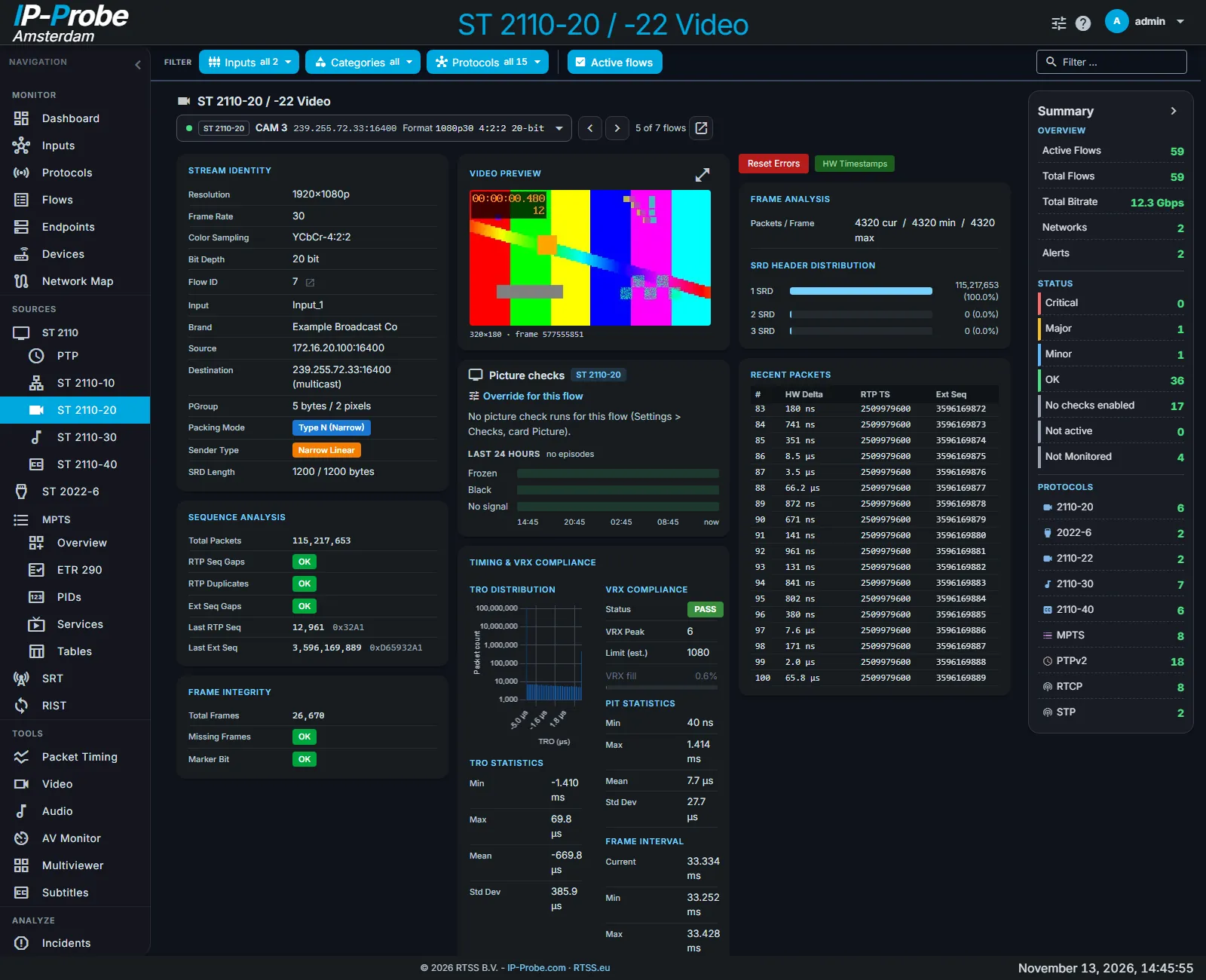
PTP: is the clock good?
When the clock is wrong, every stream that follows it is wrong too. The PTP page has one view per clock, that is one domain with one grandmaster, with all inputs together.
- Grandmaster, Sync, and probe and path panels
- Message rates of Sync, Announce and Delay_Resp against the declared rate
- Competing masters and BMCA, grandmaster changes with time
- Sync interval, jitter and correction field over time
- ST 2110-10 system timing: media clock of every ST 2110 and AES67 flow, locked or drifting, per sender device
ST 2059-2 profile check
| Item | Checked against |
|---|---|
| Domain | 0 to 127, default 127 |
| Sync interval | 125 ms to 0.5 s, measured and declared |
| Announce interval | 125 ms to 2 s, measured and declared |
| Timescale | PTP, not ARB |
| Clock class | 6 good, 7 holdover, 248 and others check |
| Delay mechanism | E2E default, P2P check |
Each line shows OK, Check or Fail.
Typical faults it shows
A free-running grandmaster with a 1970 timescale. A Sync rate two times off the declared rate. Two masters fighting for the domain. Senders that run on another grandmaster than the rest of the plant. A switch that does not forward PTP to the monitoring port.
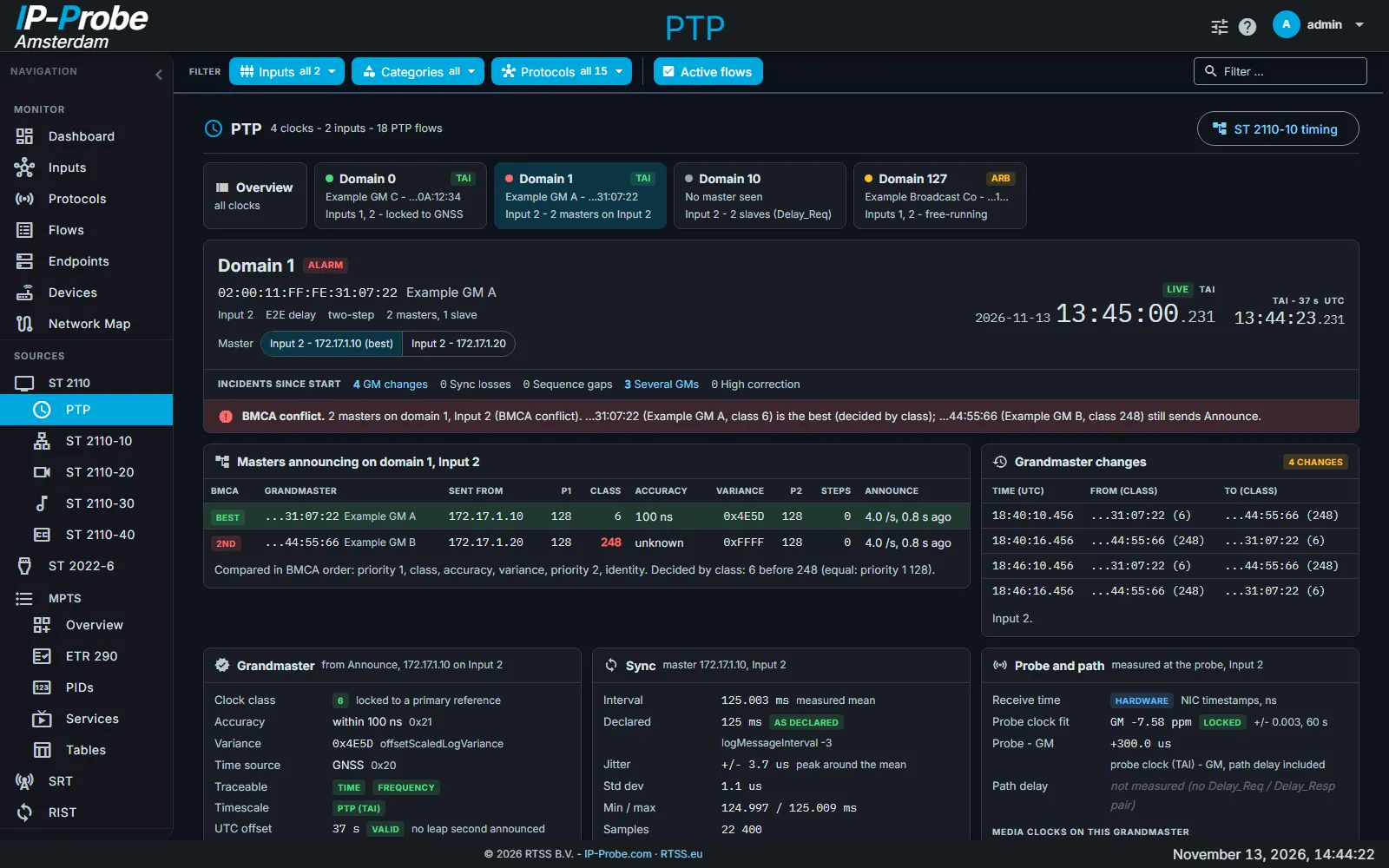
Audio: meters, loudness, listening
Level meters for up to 16 channels, loudness to the standard set on the probe, and listening in the browser.
- Loudness checks per track: too loud, too quiet, off target, true peak over, silence
- ST 2110-31 AES3: parity and channel status raised as incidents
- Dolby E, AC-3 and E-AC-3 in a pair recognized and decoded while you listen
- Packet timing and sequence analysis per audio flow
Ancillary data: timecode, captions, cues
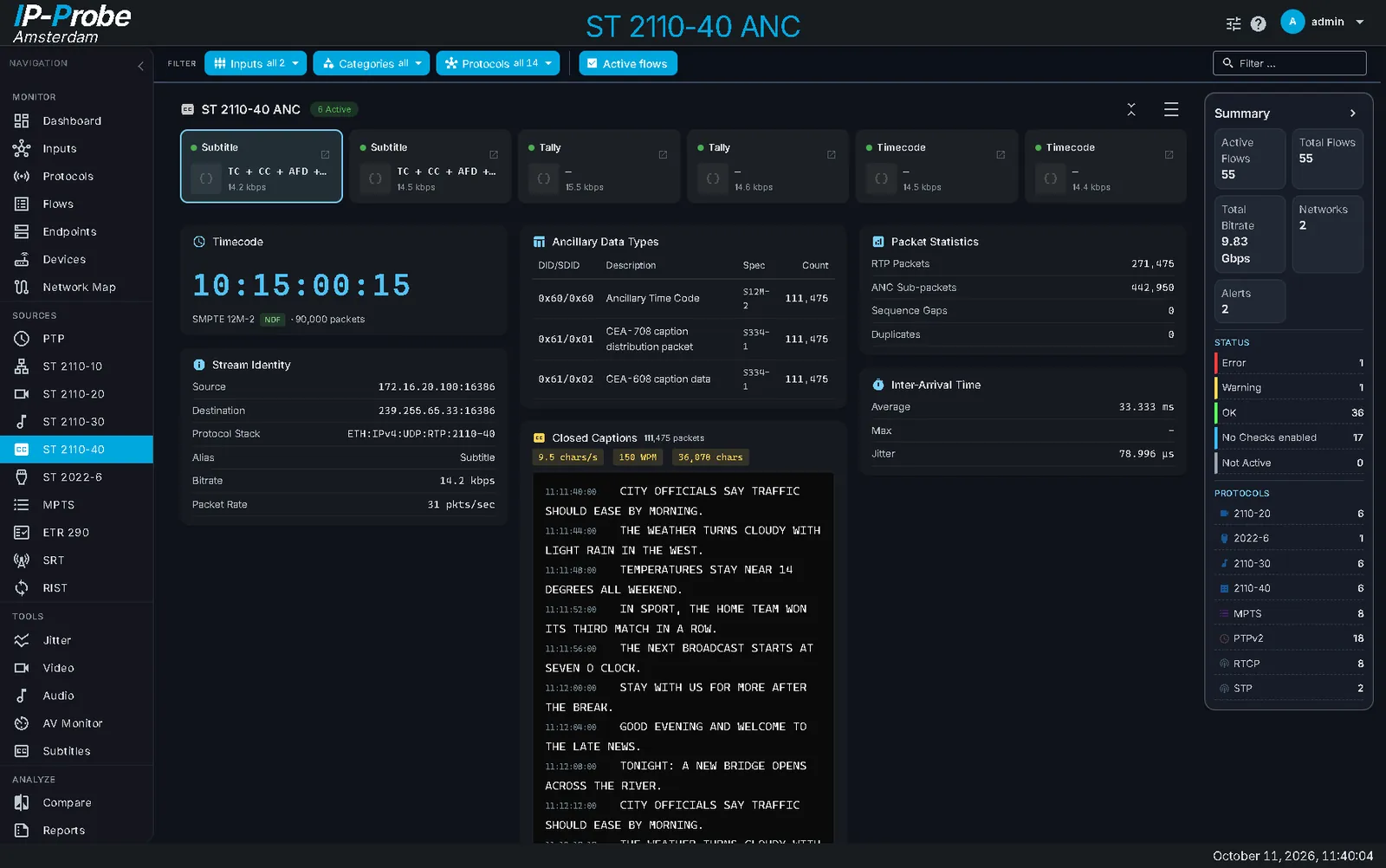
The ST 2110-40 page decodes the ANC packets of a flow and lists every data type by DID and SDID.
- Timecode (ATC) with its state
- CEA-608 and CEA-708 closed captions drawn as on a TV, with a caption report
- Active Format Description (AFD)
- SCTE-104 messages from automation, logged, kept in history and sent as alarms
- Captions stopped incident when a caption service stops while the flow goes on
Seamless protection: both paths
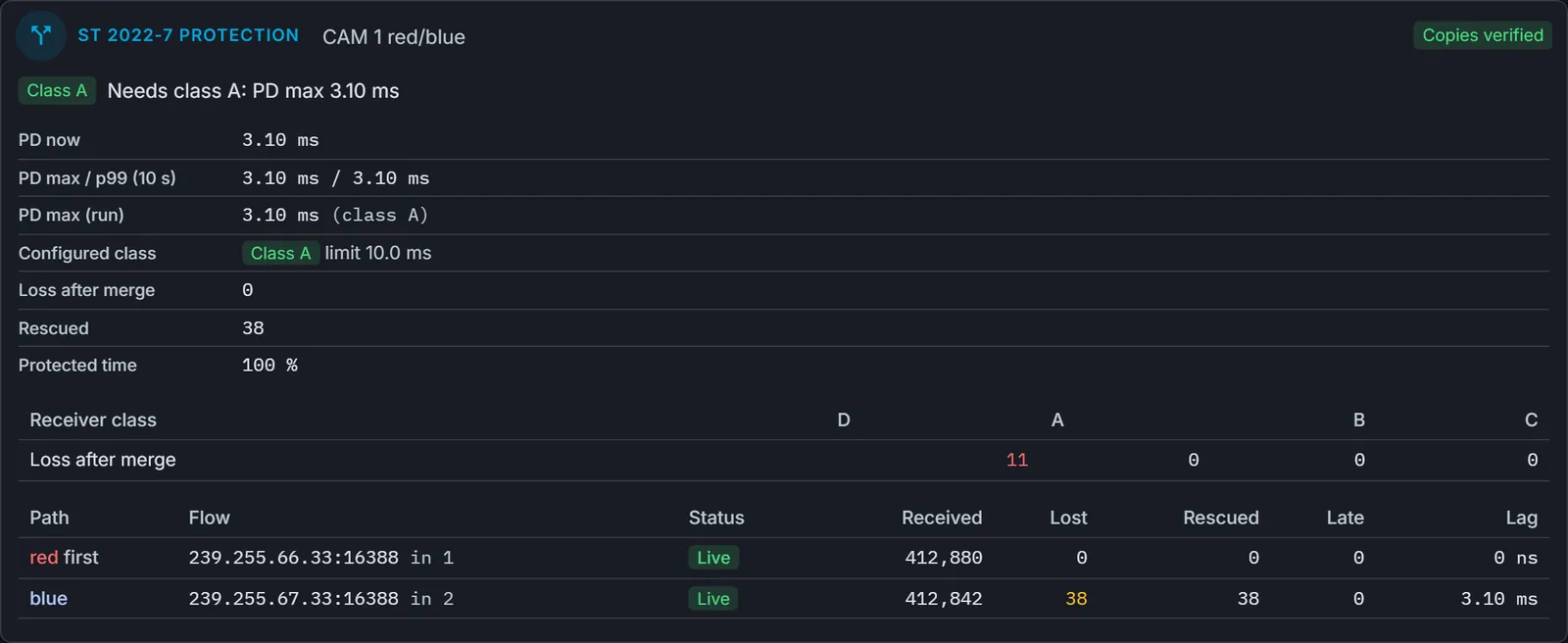
The probe finds the red and blue legs of a pair by itself: the same RTP stream from another source, on another destination, port, input or VLAN. It confirms the pair only when both legs carry the same packets. Pairs can also be set by hand with a label and a receiver class.
- Loss per path and packets rescued by the other path
- Loss after merge: packets no leg delivered
- Path differential (PD) and the receiver class it needs
- PD change after a network path changes
Receiver classes: PD a receiver absorbs
| Class | Max path differential |
|---|---|
| Class D | 150 us |
| Class A | 10 ms |
| Class B | 50 ms |
| Class C | 450 ms (150 ms at 270 Mbit/s or more) |
The panel names the smallest class that copes with the PD of the last 10 seconds, for example "Needs class B: PD max 23.0 ms".
SDI over IP
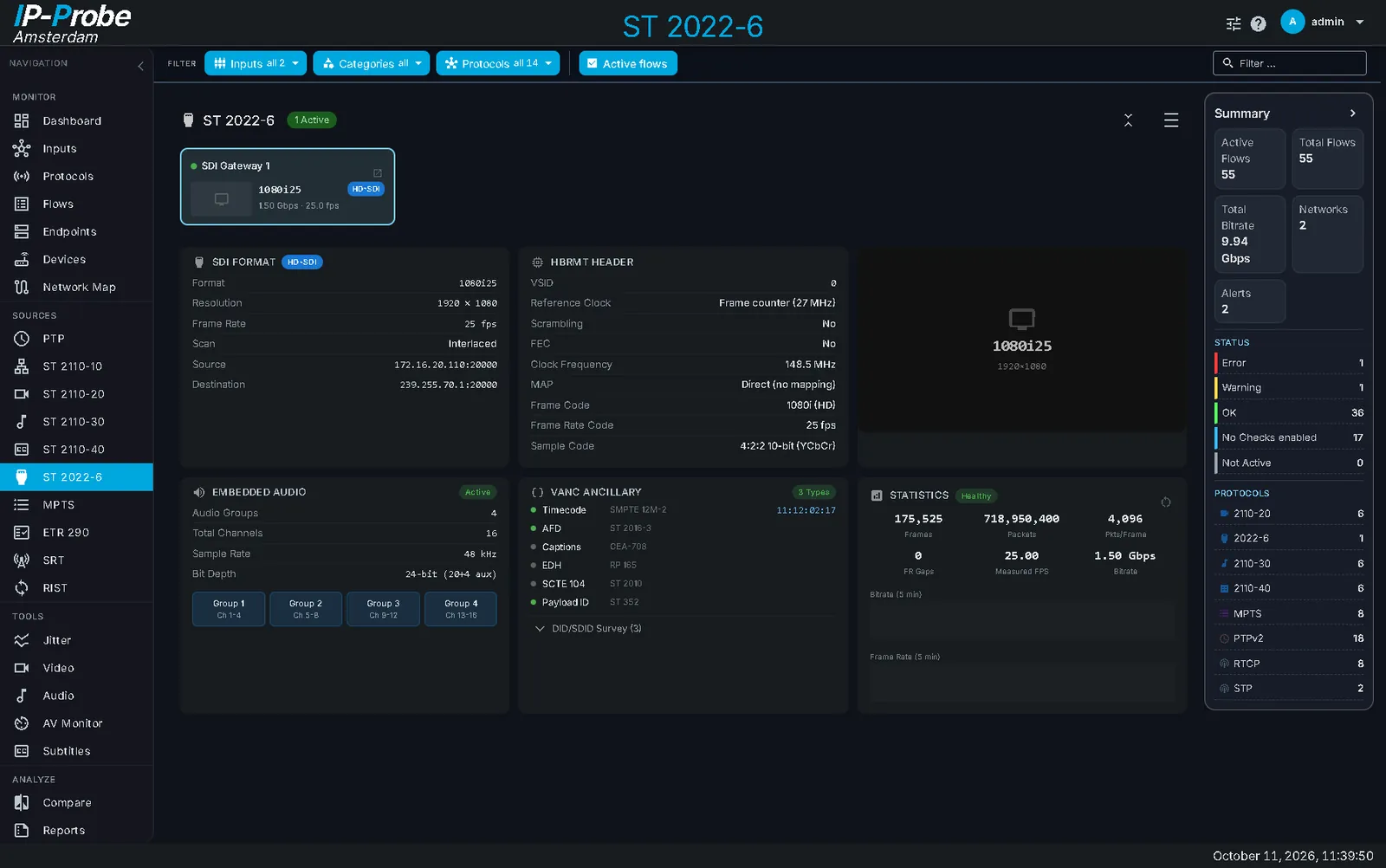
For plants that carry SDI in ST 2022-6, the probe reads the HBRMT header and the SDI inside it.
- SDI format, frame rate and scan
- HBRMT header: reference clock, frame and sample codes
- Embedded audio groups and channels
- VANC: timecode, AFD, captions, EDH, SCTE-104, payload ID
- Black, frozen and out-of-gamut picture checks
All flows in one timing table
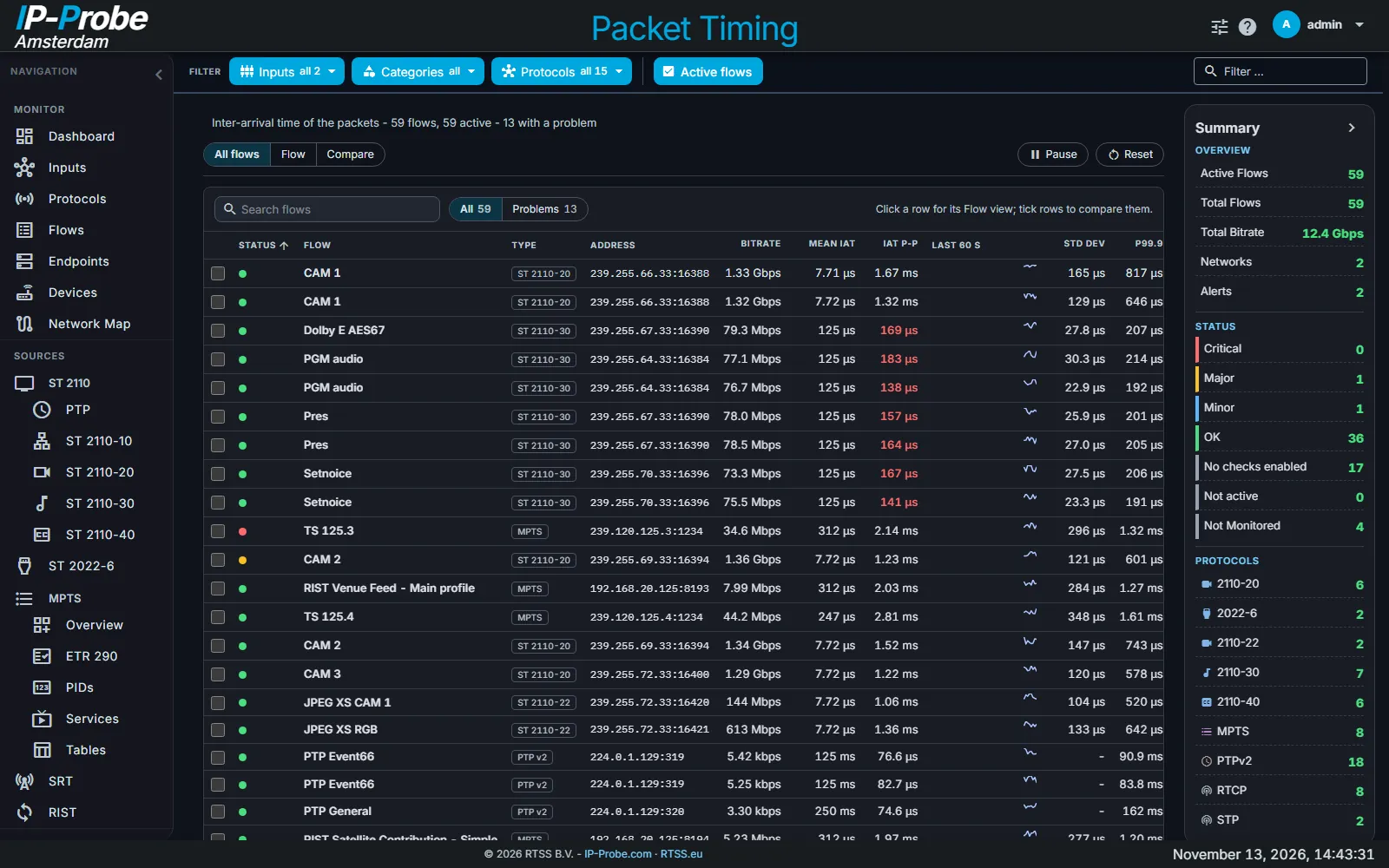
The Packet Timing page lists every flow, worst first, with its inter-arrival time and jitter. Pick a flow for its trends, or compare flows side by side.
- IAT peak-to-peak, standard deviation and percentiles
- CINST and VRX peaks per second for ST 2110-20
- RTP jitter of RTP flows
- Trends of the last hour and the last day
Which options this needs
The 2110 option opens the PTP, ST 2110-10, -20, -30 and -40 pages and the test stream generator. The picture of ST 2110-20 needs Video, the audio parts of ST 2110-30 need Audio, the ST 2110-40 page needs Ancillary. ST 2022-6 has its own option. ST 2022-7 and packet timing are in Base. How licensing works.